Постановление 9ААС от 02.07.2026 (запрет на выезд)
| Судебное дело | Банкротство Арциновича — Банкротство · 2024–2026 |
|---|---|
| Дата | |
| Тип документа | Решение суда |
| Инстанция | Апелляция |
| Суд | Девятый арбитражный апелляционный суд |
| Номер дела | А40-40034/2024 |
| Страниц | 5 |
| Источник | Материалы дела |
| Добавлен | 08.10.2026 |
Материал отредактирован для защиты персональных данных: скрыты ФИО всех лиц (кроме фамилии Арцинович), номера дел и актов, подписи, печати и реквизиты. Скрытые сведения не восстанавливаются из изображения или текста.
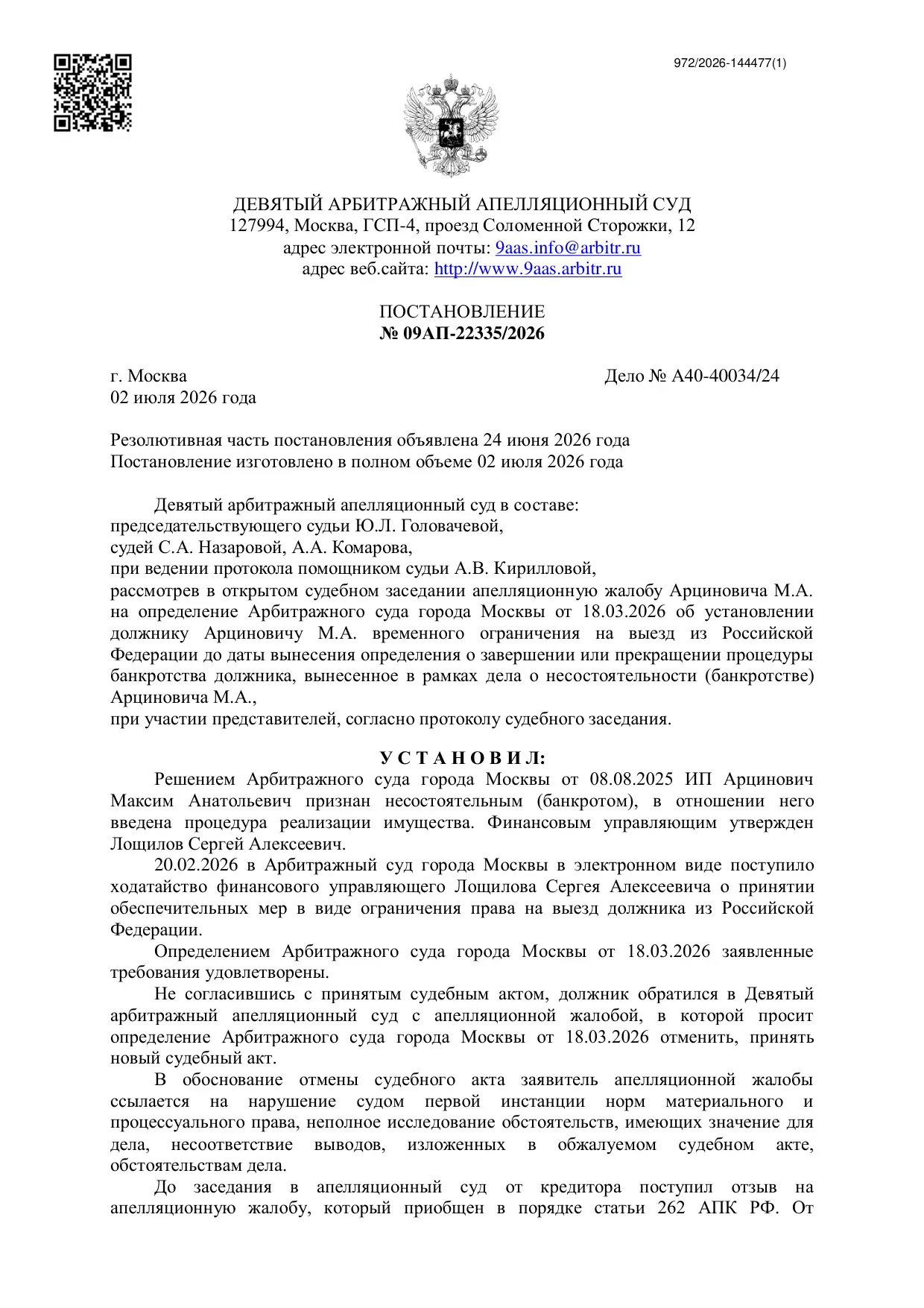
Текстовая версия
1
972/2026-144477(1)
ДЕВЯТЫЙ АРБИТРАЖНЫЙ АПЕЛЛЯЦИОННЫЙ СУД 127994, Москва, ГСП-4, проезд Соломенной Cторожки, 12
адрес электронной почты: 9aas.info@arbitr.ru
адрес веб.сайта: http://www.9aas.arbitr.ru
ПОСТАНОВЛЕНИЕ № 09АП-22335/2026 г. Москва Дело № А40-40034/24 02 июля 2026 года Резолютивная часть постановления объявлена 24 июня 2026 года Постановление изготовлено в полном объеме 02 июля 2026 года
Девятый арбитражный апелляционный суд в составе: председательствующего судьи Ю.Л. Головачевой, судей С.А. Назаровой, А.А. Комарова, при ведении протокола помощником судьи А.В. Кирилловой, рассмотрев в открытом судебном заседании апелляционную жалобу Арциновича М.А. на определение Арбитражного суда города Москвы от 18.03.2026 об установлении должнику Арциновичу М.А. временного ограничения на выезд из Российской Федерации до даты вынесения определения о завершении или прекращении процедуры банкротства должника, вынесенное в рамках дела о несостоятельности (банкротстве) Арциновича М.А., при участии представителей, согласно протоколу судебного заседания.
У С Т А Н О В И Л: Решением Арбитражного суда города Москвы от 08.08.2025 ИП Арцинович Максим Анатольевич признан несостоятельным (банкротом), в отношении него введена процедура реализации имущества. Финансовым управляющим утвержден Лощилов Сергей Алексеевич.
20.02.2026 в Арбитражный суд города Москвы в электронном виде поступило ходатайство финансового управляющего Лощилова Сергея Алексеевича о принятии обеспечительных мер в виде ограничения права на выезд должника из Российской Федерации.
Определением Арбитражного суда города Москвы от 18.03.2026 заявленные требования удовлетворены.
Не согласившись с принятым судебным актом, должник обратился в Девятый арбитражный апелляционный суд с апелляционной жалобой, в которой просит определение Арбитражного суда города Москвы от 18.03.2026 отменить, принять новый судебный акт.
В обоснование отмены судебного акта заявитель апелляционной жалобы ссылается на нарушение судом первой инстанции норм материального и процессуального права, неполное исследование обстоятельств, имеющих значение для дела, несоответствие выводов, изложенных в обжалуемом судебном акте, обстоятельствам дела.
До заседания в апелляционный суд от кредитора поступил отзыв на апелляционную жалобу, который приобщен в порядке статьи 262 АПК РФ. От
2
А40-40034/24
2
должника – дополнительные документы, в приобщении которых отказано ввиду отсутствия доказательств невозможности представить данные документы в суд первой инстанции.
Должник в судебном заседании поддержал доводы апелляционной жалобы на вопрос апелляционного суда пояснил, что заграничный паспорт необходим для отдыха за границей, на лечение, командировки.
Представитель кредитора возражал против удовлетворения апелляционной жалобы.
Представитель должника ходатайствовал об отмене обеспечительных документов. Апелляционный суд протокольным определением оставил без рассмотрения ходатайство должника об отмене обеспечительных мер ввиду того, что данного заявление подлежит рассмотрению судом, принявшие обеспечительные меры (статья 97 АПК РФ).
Иные лица, участвующие в деле, уведомленные судом о времени и месте слушания дела, в том числе публично, посредством размещения информации на официальном сайте в сети Интернет, в судебное заседание не явились, в связи с чем, апелляционная жалоба рассматривается в их отсутствие, исходя из норм статьи 156 АПК РФ.
Руководствуясь статьями 123, 266 и 268 АПК РФ, изучив представленные в дело доказательства, рассмотрев доводы апелляционной жалобы, апелляционный суд не находит оснований для отмены или изменения определения арбитражного суда, принятого в соответствии с законодательством РФ и обстоятельствами дела, и удовлетворения апелляционной жалобы, исходя из следующего.
Принимая обжалуемый судебный акт, суд первой инстанции исходил из следующего.
20.02.2026 в Арбитражный суд города Москвы в электронном виде поступило ходатайство финансового управляющего Лощилова Сергея Алексеевича о принятии обеспечительных мер в виде ограничения права на выезд должника из Российской Федерации.
Заявление мотивировано тем, что должник владеет ювелирным бизнесом в Лондоне (Соединенное Королевство Великобритании и Северной Ирландии) и Дубае (ОАЭ), имеет паспорт гражданина иностранного государства (Федерация Сент-Китс и Невис), совершает регулярные заграничные поездки с туристическими и иными целями, не направленными на погашение задолженности перед кредиторами.
В соответствии с положениями статьи 90 Арбитражного процессуального кодекса Российской Федерации арбитражный суд по заявлению лица, участвующего в деле, может принять срочные временные меры, направленные на обеспечение иска или имущественных интересов заявителя (обеспечительные меры). Обеспечительные меры допускаются, если непринятие этих мер может затруднить или сделать невозможным исполнение судебного акта, а также в целях предотвращения причинения значительного ущерба заявителю.
В силу части 1 статьи 91 Арбитражного процессуального кодекса Российской Федерации к числу обеспечительных мер относится как наложение ареста на имущество, принадлежащие ответчику и находящиеся у него или других лиц; так и запрещение ответчику и другим лицам совершать определенные действия, касающиеся предмета спора.
Обстоятельства, имеющие значение для правильного рассмотрения дела, определяются арбитражным судом на основании требований и возражений лиц, участвующих в деле, в соответствии с подлежащими применению нормами материального права.
Как установлено пунктом 14 Постановления Пленума Высшего Арбитражного Суда Российской Федерации от 01.06.2023 №15 «О некоторых вопросах принятия
3
А40-40034/24
3
судами мер по обеспечению иска, обеспечительных мер и мер предварительной защиты» рассматривая заявление о принятии обеспечительных мер, суд устанавливает наличие оснований для принятия обеспечительных мер, определяет, насколько конкретная мера, о принятии которой просит заявитель, связана с предметом заявленного требования, соразмерна ему и каким образом она обеспечит фактическую реализацию целей принятия обеспечительных мер.
Суд принимает обеспечительные меры при установлении хотя бы одного из оснований для их принятия.
В связи с этим при оценке доводов заявителя судам следует, в частности, иметь в виду:
разумность и обоснованность требования заявителя о принятии обеспечительных мер;
связь испрашиваемой обеспечительной меры с предметом заявленного требования;
вероятность причинения заявителю значительного ущерба в случае непринятия обеспечительных мер;
обеспечение баланса интересов сторон; - предотвращение нарушения при принятии обеспечительных мер публичных интересов, интересов третьих лиц.
Кроме того, суд оценивает, насколько истребуемая заявителем конкретная обеспечительная мера связана с предметом заявленного требования, соразмерна ему и каким образом она обеспечит фактическую реализацию целей обеспечительных мер, обусловленных основаниями, предусмотренными частью второй статьи 90 Арбитражного процессуального кодекса Российской Федерации.
Таким образом, до вынесения судебного решения по делу для эффективного исполнения будущего решения, а также в целях обеспечения баланса интересов заинтересованных сторон в спорном правоотношении обеспечительные меры должны быть направлены на закрепление существующего состояния отношений (status quo) между сторонами.
Частью 2 статьи 27 Конституции Российской Федерации гарантируется право каждого свободно выезжать за пределы Российской Федерации, которое, однако, в силу части 3 статьи 55 Конституции Российской Федерации может быть ограничено федеральным законом в той мере, в какой это необходимо в целях защиты основ конституционного строя, нравственности, здоровья, прав и законных интересов других лиц, обеспечения обороны страны и безопасности государства.
В силу пункта 5 статьи 15 Федерального закона от 15.08.1996 № 114-ФЗ «О порядке выезда из Российской Федерации и въезда в Российскую Федерацию» право гражданина Российской Федерации на выезд из Российской Федерации может быть временно ограничено в случае, если он уклоняется от исполнения обязательств, наложенных на него судом, - до исполнения обязательств либо до достижения согласия сторонами.
Согласно пункту 3 статьи 213.24 Закона о банкротстве в случае признания гражданина банкротом арбитражный суд вправе вынести определение о временном ограничении права на выезд гражданина из Российской Федерации.
Временное ограничение права на выезд гражданина из Российской Федерации действует до даты вынесения определения о завершении или прекращении производства по делу о банкротстве гражданина, в том числе в результате утверждения арбитражным судом мирового соглашения.
При наличии уважительной причины, по которой требуется выезд гражданина из Российской Федерации, по ходатайству гражданина и с учетом мнения кредиторов и финансового управляющего арбитражный суд вправе досрочно отменить временное ограничение права на выезд гражданина из Российской Федерации.
4
А40-40034/24
4
При применении данной правовой нормы следует учитывать не только интересы участников дела о банкротстве, но и права должника как гражданина Российской Федерации. Из анализа выше названных норм права следует, что установление запрета на выезд из Российской Федерации имеет правовую природу обеспечительных мер, в связи с чем в силу положений статьи 65 Арбитражного процессуального кодекса Российской Федерации заявитель должен доказать обстоятельства, на которые он ссылается, и обосновать причины обращения с подобным требованием конкретными доказательствами, подтверждающими необходимость ограничения права на выезд гражданина из Российской Федерации.
Поскольку выезд должника за пределы Российской Федерации в рамках введенной в отношении должника процедуры банкротства сопряжен с необходимостью расходования денежных средств из конкурсной массы, подобное не соответствует целям процедуры реализации имущества гражданина и нарушает права кредиторов.
Кроме того, данный запрет позволяет избежать уклонения должника от проведения мероприятий в процедуре реализации его имущества и защитить интересы кредиторов.
При этом механизм банкротства граждан является правовой основой для чрезвычайного (экстраординарного) способа освобождения должника от требований кредиторов, как заявленных в процедурах банкротства, так и не заявленных. При этом должник, действующий добросовестно, должен претерпеть неблагоприятные для себя последствия признания банкротом, выражающиеся, прежде всего, в передаче в конкурсную массу максимально возможного по объему имущества и имущественных прав в целях погашения (частичного погашения) требований кредиторов, обязательства перед которыми должником надлежащим образом исполнены не были. Иными словами, механизм банкротства граждан не может быть использован в ущерб интересов кредиторов.
Принимая во внимание указанные обстоятельства, суд первой инстанции пришел к выводу об обоснованности ходатайства финансового управляющего об установлении временного ограничения права на выезд должника с территории Российской Федерации.
Апелляционный суд, соглашаясь с выводами суда первой инстанции, отклоняет доводы апелляционной жалобы ввиду следующего.
Финансовый управляющий действовал добросовестно: направил запросы в Пограничную службу ФСБ России, получил отказы в их внесудебном предоставлении (ответы от 16.12.2025 и от 06.02.2026 с указанием на необходимость судебного запроса) и заявил ходатайство об истребовании сведений судом, удовлетворенное определением от 24.03.2026. Истребованные сведения получены.
Как указывает кредитором и не оспорено апеллянтом, согласно официальным сведениям ОПК ФСБ России в МАП Шереметьево «О пересечении государственной границы Российской Федерации» Должник за период с 2001 по 2026 год пересекал государственную границу 960 раз, а после введения процедуры (с 25.11.2024) 18 раз, что составляет 9 заграничных поездок: 5 поездок в ОАЭ, 2 в Турцию, 2 в Грузию. Из них 11 пересечений совершено после признания должника банкротом (08.08.2025). Последняя поездка - с 13.02.2026 по 02.03.2026 (ОАЭ). Поездки совершались по двум заграничным паспортам гражданина Российской Федерации, причем второй из них использован впервые 24.09.2025, то есть уже в ходе процедуры банкротства.
То обстоятельство, что по каждой из поездок должник возвращался, не свидетельствует об отсутствии риска и не делает меру излишней.
Иные доводы заявителя апелляционной жалобы не содержат ссылок на факты, которые не были бы проверены и не учтены судом первой инстанции при рассмотрении дела и имели бы юридическое значение для вынесения судебного акта, влияли на обоснованность и законность судебного акта, либо опровергали выводы суда первой
5
А40-40034/24
5
инстанции, в связи с чем, признаются судом апелляционной инстанции несостоятельными и не могут служить основанием для отмены определения суда первой инстанции.
При таких обстоятельствах, арбитражный суд первой инстанции всесторонне и полно исследовал материалы дела, дал надлежащую правовую оценку всем доказательствам, применил нормы материального права, подлежащие применению, не допустив нарушений норм процессуального права.
Выводы, содержащиеся в судебном акте, соответствуют фактическим обстоятельствам дела, и оснований для его отмены, в соответствии со статьей 270 АПК РФ, апелляционная инстанция не усматривает.
На основании изложенного и руководствуясь статьями 176, 266 - 269, 272 Арбитражного процессуального кодекса Российской Федерации, Девятый арбитражный апелляционный суд
П О С Т А Н О В И Л: Определение Арбитражного суда города Москвы от 18.03.2026 оставить без изменения, а апелляционную жалобу – без удовлетворения.
Постановление вступает в законную силу со дня принятия и может быть обжаловано в течение одного месяца со дня изготовления в полном объеме в Арбитражный суд Московского округа.
Председательствующий судья: Ю.Л. Головачева
Судьи: С.А. Назарова
А.А. Комаров
Перевод неофициальный.
Judgment of the Ninth Arbitrazh Court of Appeal of 2 July 2026 — travel ban on the debtor
[[PAGE 1]]
[Document No. 972/2026-144477(1)]
NINTH ARBITRAZH COURT OF APPEAL
127994, Moscow, GSP-4, Proezd Solomennoy Storozhki 12
e-mail: 9aas.info@arbitr.ru — website: http://www.9aas.arbitr.ru
JUDGMENT No. 09AP-22335/2026
Moscow — Case No. A40-40034/24 — 2 July 2026
The operative part of the judgment was announced on 24 June 2026. The judgment was drawn up in full on 2 July 2026.
The Ninth Arbitrazh Court of Appeal, composed of presiding judge Yu. L. Golovacheva and judges S. A. Nazarova and A. A. Komarov, with the record kept by assistant judge A. V. Kirillova, having examined in open court the appeal of M. A. Artsinovich against the ruling of the Arbitrazh Court of the City of Moscow of 18.03.2026 imposing on the debtor M. A. Artsinovich a temporary restriction on leaving the Russian Federation until the date of the ruling completing or terminating the debtor's bankruptcy procedure, issued in the framework of the insolvency (bankruptcy) case of M. A. Artsinovich, with the participation of the representatives as recorded in the minutes of the hearing,
HAS ESTABLISHED:
By decision of the Arbitrazh Court of the City of Moscow of 08.08.2025, individual entrepreneur Maxim Anatolyevich Artsinovich was declared insolvent (bankrupt) and a procedure for the realisation of his property was introduced in respect of him. Sergey Alekseevich Loshchilov was approved as insolvency administrator.
On 20.02.2026 an application by the insolvency administrator Sergey Alekseevich Loshchilov for interim measures in the form of a restriction of the debtor's right to leave the Russian Federation was received by the Arbitrazh Court of the City of Moscow in electronic form.
By ruling of the Arbitrazh Court of the City of Moscow of 18.03.2026 the claims made were granted.
Disagreeing with the judicial act adopted, the debtor applied to the Ninth Arbitrazh Court of Appeal with an appeal in which he seeks the setting aside of the ruling of the Arbitrazh Court of the City of Moscow of 18.03.2026 and the adoption of a new judicial act.
In support of the setting aside of the judicial act, the appellant relies on a breach by the court of first instance of the rules of substantive and procedural law, on the incomplete examination of circumstances of significance for the case, and on the inconsistency between the conclusions set out in the judicial act appealed against and the circumstances of the case.
Before the hearing, the appeal court received the creditor's response to the appeal, which was added to the file under Article 262 of the Arbitrazh Procedure Code. From the debtor it received additional documents, which were not added to the file for lack of evidence that it had been impossible to submit those documents to the court of first instance.
[[PAGE 2]]
At the hearing the debtor maintained the arguments of the appeal and, in reply to a question from the appeal court, explained that his foreign travel passport was necessary for holidays abroad, for medical treatment and for business trips.
The creditor's representative objected to the appeal being allowed.
The debtor's representative applied for the lifting of the interim measures. By a ruling entered in the minutes, the appeal court left the debtor's application for the lifting of the interim measures unexamined, on the ground that such an application is to be examined by the court which adopted the interim measures (Article 97 of the Arbitrazh Procedure Code).
The other persons participating in the case, notified by the court of the time and place of the hearing, including publicly through the posting of information on the official website on the Internet, did not appear at the hearing, and the appeal is therefore examined in their absence, pursuant to Article 156 of the Arbitrazh Procedure Code.
Guided by Articles 123, 266 and 268 of the Arbitrazh Procedure Code, having examined the evidence submitted in the case and considered the arguments of the appeal, the appeal court finds no grounds for setting aside or varying the ruling of the arbitrazh court, which was adopted in accordance with the legislation of the Russian Federation and the circumstances of the case, or for allowing the appeal, on the following grounds.
In adopting the judicial act appealed against, the court of first instance proceeded as follows.
On 20.02.2026 an application by the insolvency administrator Sergey Alekseevich Loshchilov for interim measures in the form of a restriction of the debtor's right to leave the Russian Federation was received by the Arbitrazh Court of the City of Moscow in electronic form.
The application was based on the fact that the debtor owns a jewellery business in London (United Kingdom of Great Britain and Northern Ireland) and Dubai (UAE), holds the passport of a citizen of a foreign State (the Federation of Saint Kitts and Nevis), and makes regular foreign trips for tourist and other purposes not directed at repaying the debt to the creditors.
Under Article 90 of the Arbitrazh Procedure Code of the Russian Federation, an arbitrazh court may, on the application of a person participating in the case, adopt urgent temporary measures aimed at securing the claim or the property interests of the applicant (interim measures). Interim measures are permitted if the failure to adopt them may make it difficult or impossible to enforce the judicial act, and also in order to prevent significant damage being caused to the applicant.
Under Article 91(1) of the Arbitrazh Procedure Code of the Russian Federation, interim measures include both the attachment of property belonging to the respondent and held by him or by other persons, and the prohibition of the respondent and other persons from performing certain acts relating to the subject matter of the dispute.
The circumstances of significance for the correct examination of the case are determined by the arbitrazh court on the basis of the claims and objections of the persons participating in the case, in accordance with the rules of substantive law to be applied.
[[PAGE 3]]
As established by paragraph 14 of the Resolution of the Plenum of the Supreme Arbitrazh Court of the Russian Federation of 01.06.2023 No. 15 "On certain issues concerning the adoption by courts of measures securing a claim, interim measures and preliminary protective measures", when examining an application for interim measures the court establishes whether grounds for adopting interim measures exist, determines how far the specific measure sought by the applicant is connected with the subject matter of the claim made, whether it is proportionate to it, and in what way it will ensure the actual attainment of the objectives of adopting interim measures.
The court adopts interim measures where at least one of the grounds for their adoption is established.
In this connection, when assessing the applicant's arguments, the courts should in particular bear in mind:
- the reasonableness and justification of the applicant's request for interim measures;
- the connection between the interim measure sought and the subject matter of the claim made;
- the likelihood of significant damage being caused to the applicant if interim measures are not adopted;
- the striking of a balance between the interests of the parties;
- the prevention, when interim measures are adopted, of any infringement of public interests or the interests of third parties.
In addition, the court assesses how far the specific interim measure sought by the applicant is connected with the subject matter of the claim made, whether it is proportionate to it, and in what way it will ensure the actual attainment of the objectives of interim measures based on the grounds provided for by Article 90(2) of the Arbitrazh Procedure Code of the Russian Federation.
Thus, pending the adoption of a judicial decision in the case, for the effective enforcement of the future decision, and also in order to ensure a balance of the interests of the parties concerned in the disputed legal relationship, interim measures must be aimed at preserving the existing state of relations (status quo) between the parties.
Article 27(2) of the Constitution of the Russian Federation guarantees everyone the right freely to leave the Russian Federation, which, however, under Article 55(3) of the Constitution of the Russian Federation, may be restricted by federal law to the extent necessary for the protection of the foundations of the constitutional order, morality, health, and the rights and legitimate interests of others, and for ensuring the defence of the country and the security of the State.
Under Article 15(5) of Federal Law No. 114-FZ of 15.08.1996 "On the procedure for departure from the Russian Federation and entry into the Russian Federation", the right of a citizen of the Russian Federation to leave the Russian Federation may be temporarily restricted if he evades the performance of obligations imposed on him by a court — until the obligations are performed or until the parties reach agreement.
Under Article 213.24(3) of the Bankruptcy Law, where a citizen is declared bankrupt, the arbitrazh court is entitled to issue a ruling temporarily restricting the citizen's right to leave the Russian Federation.
The temporary restriction of a citizen's right to leave the Russian Federation is in force until the date of the ruling completing or terminating the proceedings in the citizen's bankruptcy case, including as a result of the approval by the arbitrazh court of an amicable settlement.
Where there is a valid reason requiring the citizen to leave the Russian Federation, the arbitrazh court is entitled, on the citizen's application and taking into account the opinion of the creditors and of the insolvency administrator, to lift the temporary restriction of the citizen's right to leave the Russian Federation ahead of time.
[[PAGE 4]]
In applying this rule of law, account must be taken not only of the interests of the participants in the bankruptcy case, but also of the rights of the debtor as a citizen of the Russian Federation. It follows from an analysis of the above rules of law that the imposition of a ban on leaving the Russian Federation has the legal nature of interim measures, and therefore, under Article 65 of the Arbitrazh Procedure Code of the Russian Federation, the applicant must prove the circumstances on which he relies and substantiate the reasons for making such a request with specific evidence confirming the need to restrict the citizen's right to leave the Russian Federation.
Since the debtor's departure from the Russian Federation in the framework of the bankruptcy procedure introduced in respect of him entails the need to spend funds from the bankruptcy estate, this does not correspond to the objectives of the procedure for the realisation of a citizen's property and infringes the rights of the creditors.
In addition, this ban makes it possible to prevent the debtor from evading the measures taken in the procedure for the realisation of his property and to protect the interests of the creditors.
At the same time, the mechanism of citizens' bankruptcy is the legal basis for an extraordinary means of releasing the debtor from creditors' claims, both those declared in the bankruptcy proceedings and those not declared. A debtor acting in good faith must endure the unfavourable consequences of being declared bankrupt, consisting above all in the transfer to the bankruptcy estate of the maximum possible volume of property and property rights in order to repay (partially repay) the claims of the creditors whose claims the debtor failed duly to satisfy. In other words, the mechanism of citizens' bankruptcy cannot be used to the detriment of the creditors' interests.
Taking the above circumstances into account, the court of first instance concluded that the insolvency administrator's application for a temporary restriction of the debtor's right to leave the territory of the Russian Federation was well-founded.
The appeal court, agreeing with the conclusions of the court of first instance, rejects the arguments of the appeal on the following grounds.
The insolvency administrator acted in good faith: he sent requests to the Border Service of the FSB of Russia, received refusals to provide the information out of court (replies of 16.12.2025 and of 06.02.2026 indicating the need for a judicial request), and made an application for the information to be obtained by the court, which was granted by the ruling of 24.03.2026. The information requested was obtained.
As the creditor states and the appellant has not disputed, according to the official information of the Border Control Unit of the FSB of Russia at Sheremetyevo International Airport "On the crossing of the State Border of the Russian Federation", the Debtor crossed the State Border 960 times in the period from 2001 to 2026, and 18 times after the introduction of the procedure (from 25.11.2024), which amounts to 9 foreign trips: 5 trips to the UAE, 2 to Türkiye, 2 to Georgia. Of these, 11 crossings were made after the debtor was declared bankrupt (08.08.2025). The last trip was from 13.02.2026 to 02.03.2026 (UAE). The trips were made using two foreign travel passports of a citizen of the Russian Federation, the second of which was used for the first time on 24.09.2025, that is to say, already in the course of the bankruptcy procedure.
The fact that the debtor returned from each of the trips does not indicate the absence of a risk and does not make the measure superfluous.
The other arguments of the appellant do not contain references to facts which were not verified and taken into account by the court of first instance when examining the case and which would be of legal significance for the issuing of the judicial act, would affect the soundness and lawfulness of the judicial act, or would refute the conclusions of the court of first instance;
[[PAGE 5]]
they are therefore found by the appeal court to be unsubstantiated and cannot serve as grounds for setting aside the ruling of the court of first instance.
In these circumstances, the arbitrazh court of first instance examined the materials of the case comprehensively and fully, gave a proper legal assessment to all the evidence, and applied the rules of substantive law to be applied, without committing any breach of the rules of procedural law.
The conclusions contained in the judicial act correspond to the actual circumstances of the case, and the appellate instance finds no grounds for setting it aside under Article 270 of the Arbitrazh Procedure Code of the Russian Federation.
On the basis of the foregoing and guided by Articles 176, 266–269 and 272 of the Arbitrazh Procedure Code of the Russian Federation, the Ninth Arbitrazh Court of Appeal
HAS RULED:
To uphold the ruling of the Arbitrazh Court of the City of Moscow of 18.03.2026 and to dismiss the appeal.
The judgment enters into legal force on the day of its adoption and may be appealed against within one month of the day on which it is drawn up in full to the Arbitrazh Court of the Moscow District.
Presiding judge: Yu. L. Golovacheva
Judges: S. A. Nazarova, A. A. Komarov